Hydra MAX: Why Simultaneous Beats Switching
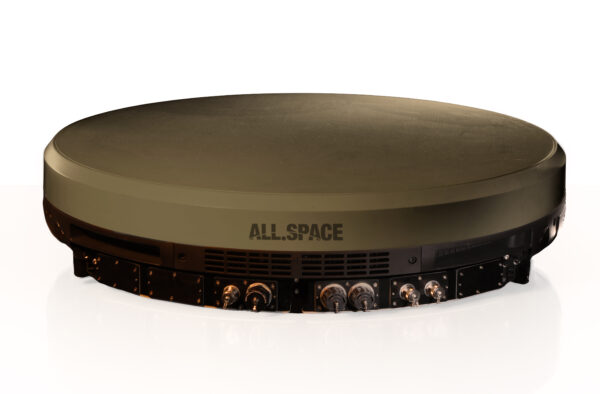
On July 28, ALL.SPACE launched Hydra MAX 2, our next-generation wideband multi-link, multi-orbit mobility terminal. The claim, “Any Operator, Any Orbit,” is easy to say. The harder question is which antenna architecture makes it possible.
That question matters because multi-orbit SATCOM is about more than seeing more satellites. For users on land or at sea, the real advantage is service continuity when one path is blocked, degraded, congested, or contested. This blog examines what happens inside Hydra MAX 2 when it keeps two satellite links active in parallel, and why that is fundamentally different from switching quickly between them.
Key idea: Hydra MAX 2 does not simply make a single connection faster. It maintains independent live links that can be controlled, optimized, and protected separately.
The core innovation: lens-array digital beamforming
Flat-panel SATCOM terminals commonly rely on phased-array, single-lens, or metamaterial antenna approaches. Each approach involves trade-offs among beam agility, power consumption, cost, and complexity, particularly when required to sustain multiple full-performance links from a single aperture.
Hydra MAX 2 takes a different approach. Its lens-array architecture pairs dielectric lens elements with independent, electronically steerable feeds, with no moving parts and no mechanically driven gimbal. Because beamforming occurs digitally rather than through analog phase shifting in RF hardware, the terminal can process each link independently, including tracking, interference rejection, and data throughput.
That digital layer also enables fast, accurate tracking. Rather than relying on received signal strength alone to estimate pointing error, as in a traditional scalar approach, Hydra MAX 2 uses vector-based tracking that measures amplitude and phase differences across the aperture in both azimuth and elevation. In practice, this allows the terminal to correct pointing error faster and with greater precision, which matters most on a moving vehicle, a rolling deck, or a vibrating platform.
True simultaneous multi-link, not fast switching
Industry terms such as “multi-link” and “multi-beam” are often used loosely, so precision is important. In this context, a beam is the steered antenna pattern used to communicate with a satellite; a link is the end-to-end communications path that the beam supports. From here on, the key point is the link: Hydra MAX 2 keeps two independent links live at the same time.
Two independent beamforming chains, each with its own RF path, operate concurrently rather than a single chain being rapidly retasked between targets. We call this wideband dual-link.
- Both links remain live concurrently, receive and transmit full duplex, each capable of full-performance operation within its designed link budget.
- Each link has its own front-end electronics, so interference, saturation, or a fault on one link does not affect the other.
- A single terminal can keep a GEO link and a MEO or LEO link open at the same time, rather than dropping one to serve the other.
The practical difference shows up under pressure. A fast-switching terminal must choose a link at any given moment, whereas a genuinely simultaneous multi-link terminal can keep a second live path available for operator-directed switching or traffic management. For operators managing coverage handoffs, contested connectivity, or terrain and sea-state effects that temporarily block a satellite, that is the difference between a brief interruption and a graceful failover path.
A Ka-band core designed for multi-orbit operation
Hydra MAX 2 provides two simultaneous full-duplex links, each supporting 500 MHz of independent instantaneous bandwidth, packaged into an 86 cm aperture. These can be used anywhere withing the Commercial or Military Ka-band. “Any Operator, Any Orbit” captures that flexibility: the terminal is designed for Ka LEO, MEO, GEO, and HEO operation and uses an open architecture rather than being optimized for a single network or orbital layer.
Network-agnostic does not mean instant operation on every network by default. It means the terminal architecture is not locked to a single modem, operator, or orbit. Practical network support still requires validation of modem interoperability, certification, and integration testing with the relevant service provider before operational use.
That flexibility is already demonstrated across SES Ka GEO and O3b mPOWER MEO networks and the Viasat GX Category 4 service, with certification for Amazon Leo and Telesat Lightspeed underway. Sovereign-modem support enables full Protected Tactical Waveform operation, and DIFI-over-fiber is available as an optional digital interface for operators building distributed ground-segment architectures.
The terminal is also designed to be field-serviceable rather than fixed-function. Field-swappable modem and edge-compute bays bring processing power closer to the tactical edge, reducing latency and easing backhaul demand without altering the terminal footprint.
Engineered for motion on land and at sea
Mobile SATCOM performance is not only about peak numbers. Antenna performance that appears strong at boresight can drop quickly once a link is steered toward the horizon, exactly where mobile platforms often need it. In our platform comparison, the newer Ka-band core shows a measurable gain over its predecessor: at a 60° scan, Hydra MAX 2 delivers 47.0 dBW of EIRP per link, compared with 41.0 dBW on the earlier Hydra 2 platform.
That 6 dB improvement represents a real gain in usable link margin at the wide scan angles where ground vehicles on rugged terrain and vessels in a working sea state actually operate. It is not a generic industry comparison, nor is it intended to replace the terminal’s maximum EIRP specification. It is a measured improvement within our own platform generation under a defined 60° scan condition.
Link control itself is, today, in the operator’s hands. Intelligent Link Management is software-defined and orchestration-ready, designed to support automated rerouting around congestion or degradation as that capability matures. As shipped today, however, link management is manual and operator-directed. Hydra MAX 2 does not yet make autonomous failover decisions. The architecture is built for that future; the operator remains the one making the call in the meantime.
What this means in practice
Strip away the marketing language, and the engineering story is simple: Hydra MAX 2 keeps two independent, full-performance links active from a single aperture. It does so across a Ka-band architecture designed for multiple operators and orbital regimes, delivering quantified performance gains at the wide scan angles that matter most for land and maritime mobility.
That is what makes Hydra MAX 2 a true multi-orbit terminal, not merely a single-network terminal with broader positioning. It is built for the operational reality of mobility: multiple networks, multiple orbital layers, changing geometry, intermittent blockage, and users who cannot afford to wait for a terminal to switch before the mission resumes.